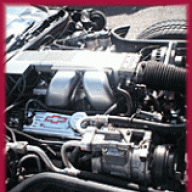
I have been running E85 in my DD for a couple of years, and the corvette for a while. The only thing you need to do is to get an adjustable Fuel pressure regulator and crank up the pressure 20%. The ECU will manage the last 10%.
E85 will shorten the life of your fuel lines and O-rings, but they will last for several years before you have to change them.
E85 need 30% more fuel by volume, than gas for the same amount of air, and 50% by weight. Look at the chemical compostion of Ethanol (C2-H5-OH), and it's pretty obvious why.
But since E85 is 60%-70% cheaper (in Sweden, probably the same in norway) than gas it's still a really good deal..
E85 + air burn, gas + air explode ==> E85 burns slower. By running with more preignition and a flatter ignition curve you can raise cylinder pressure over the whole expansion phase (yeah that means more horses). The problem is that E85 doesn't ping because of it's slowburning caracteristics and high octane. What happends is that you get the "ping effect" but you don't hear anything. If you ha a knock module you have to recalibrate it for another frequency. Use caution when you alter the ignition curve. Just for convertion the stock curve is fine.
The octane rating for E85 is 104-106 (RON/2 + MON/2).
E85 need much more energy to become gaseous, than gas, in other words you get a COOLER and DENSER mix. This is perfect if you run super or turbocharged.
E85 contains oxygen (OH) which means that you can benefit of running a overrich mixture, AFR < 9 have been used on the dyno with good results.
When running with E85 you don't get any carbon deposits. your sparkplugs will look like new after a year, but they are not. It's also a good idea to change oil more frequently.
Well all these great benefits whats the catch, you can't start you car when it's cold, below +10 Celsius (low 50s F) it starts get harder to start your car, below -18 Celsius (0 F) you can't start you car at all. If you get a fire in your gastank, with gas you just get a 1s flame, with E85 you will have a flame thrower out of your tank cap.