Welcome to the Corvette Forums at the Corvette Action Center!

throttle body cooling

bucket

Well-known member
Joined
Mar 21, 2009
Messages
839
Location
los angeles
Corvette
1992
I have studied the throttle body coolant bypass and dont believe this would efectively lower the internal temp of the TB...because the engine temp in above 210 anyway..
so....
if you bypass the coolant lines and..ran a hose to the radiator shroud and a filter on the other side ..then..you could lower the temp by a few degrees...but
in summary..its looks looks like little is to gained from all this...
...has anyone noticed any gain from just cooling the TB.?
or is my theory correct.?
jus pondering this am.....:confused

 
I have studied the throttle body coolant bypass and dont believe this would efectively lower the internal temp of the TB...because the engine temp in above 210 anyway..
so....
if you bypass the coolant lines and..ran a hose to the radiator shroud and a filter on the other side ..then..you could lower the temp by a few degrees...but
in summary..its looks looks like little is to gained from all this...
...has anyone noticed any gain from just cooling the TB.?
or is my theory correct.?
jus pondering this am.....:confused

Hi bucket!

I've bypassed the TB on all TPI swaps I've done. I don't feel the coolant passage is needed for my climate & location (KY doesn't get that cold anyway).

With that said, LT1s typically run rather hot. Hot air = less density, and that means less power.

There may be some gain with respect to lowering temperature overall- perhaps adding a lower thermostat, adding a cold air intake, bypassing the TB, wrapping headers, and getting an aluminum radiator.

These additions would likely create more consistency as opposed to finding a significant, previously untapped source of horsepower.
 
Hi bucket!

I've bypassed the TB on all TPI swaps I've done. I don't feel the coolant passage is needed for my climate & location (KY doesn't get that cold anyway).

With that said, LT1s typically run rather hot. Hot air = less density, and that means less power.

There may be some gain with respect to lowering temperature overall- perhaps adding a lower thermostat, adding a cold air intake, bypassing the TB, wrapping headers, and getting an aluminum radiator.

These additions would likely create more consistency as opposed to finding a significant, previously untapped source of horsepower.
i have an idea..
follow this logic...


you need to bypass the coolant for sure but instead of pluging the inlet outlet holes..
you put a filter on the inlet(cause its the smalest)(running to the outside air probably through the radiator shroud) and run a hose to the intake snorkel..from the outlet or large side..
this draws fresh cool air in through the TB constantly.....
in theory...cooling the entire thing-a-ma-bob.
what do ya think of that idea,.?
:cool
 
i have an idea..
follow this logic...


you need to bypass the coolant for sure but instead of pluging the inlet outlet holes..
you put a filter on the inlet(cause its the smalest)(running to the outside air probably through the radiator shroud) and run a hose to the intake snorkel..from the outlet or large side..
this draws fresh cool air in through the TB constantly.....
in theory...cooling the entire thing-a-ma-bob.
what do ya think of that idea,.?
:cool

I follow the logic- use outside, cooler, denser air- but I'm not sure the volume of air needed to get any effect would actually be able to pass through the line.

What you are talking about is essentially a low-tech forced air intercooler of sorts. To get it to work you'll need either a lot of surface area (why intercoolers and radiators have so many fins) or a lot of air in terms of volume (why some 911s had the radiator in the wing because of the path of air flow).

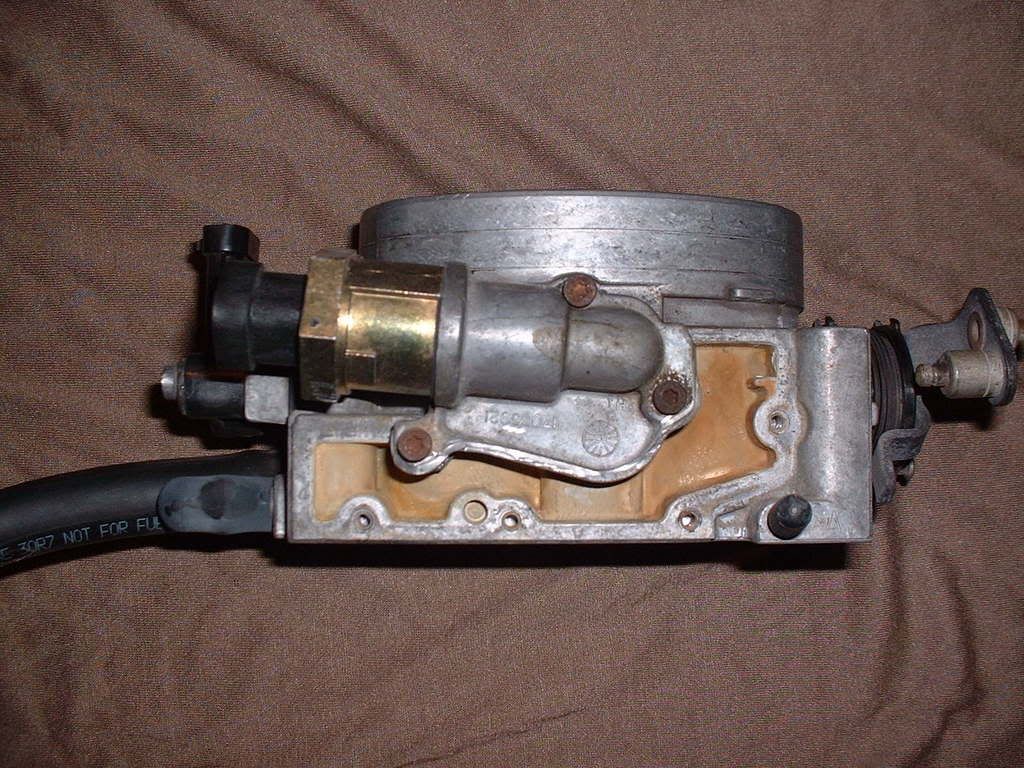
If you bypass the water passage, you could always just trim off the excess material from the housing like this...
DSCF0296.jpg
 
I follow the logic- use outside, cooler, denser air- but I'm not sure the volume of air needed to get any effect would actually be able to pass through the line.

What you are talking about is essentially a low-tech forced air intercooler of sorts. To get it to work you'll need either a lot of surface area (why intercoolers and radiators have so many fins) or a lot of air in terms of volume (why some 911s had the radiator in the wing because of the path of air flow).

If you bypass the water passage, you could always just trim off the excess material from the housing like this...
DSCF0296.jpg

you got it backwards...
not forced air from the radiator shroud..thats where the inlet/filter would be..
the large tube in the intake snorkle would "suck" air through the TB..
:w
 
i have "kit" i bought online..all it is is a brass reducer and it appears to be the wrong size..
i thought i might pull my hoses and cruse to home depot and get the right size and ...etc...etc..
 
...the large tube in the intake snorkle would "suck" air through the TB..
:w

Ok... so, you are basically saying to use filtered air, after the filter, routed through the coolant bypass- and back into the throttlebody itself somehow?
 
Ok... so, you are basically saying to use filtered air, after the filter, routed through the coolant bypass- and back into the throttlebody itself somehow?

like this..
we have re-routed our colant so it is no longer in the picture.
we are left with two openings in the TB

drivers side smaller than passenger side..
hook a hose to the smaller side and route it through the radiator shroud and put a filter on the end of it..like a valve cover filter ...
now..
on the passenger side opening put a hose on it and route it to the intake snorkel...this will be a negative pressure area and will syphon cool air through the filtered line , through the TB and into the intake snorkel...
if you use yer fluid dynamics you could run a small pipe cut at an angle to increase the air flow through the tube..this would be like a throttle body inner cooler...
of course it's only an idea..
i get em all the time
but sometimes they are ok....lol:cool
 
Problem
HEAT SOAK.
You are never going to get enough air flow to be of any benefit.Feel the top of the plenum after a run ; everything under the hood is hot ;squint:
Apparently the intake airflow is like a river; there is a slow boundary layer flow against the walls and a faster flow through the center so the main airflow does not have the chance to pickup too much heat (@ WOT )

What you need is one of these (or variants) take cool the actual intake charge.
DEI CryO2 Cryogenic Air Intake 080110 (3 INCH OD)*::*CRYOGENIC INTAKE SYSTEM CRY02*::*Air Intakes Exhaust Filters*::*AUTOTOYS
 
Problem
HEAT SOAK.
You are never going to get enough air flow to be of any benefit.Feel the top of the plenum after a run ; everything under the hood is hot ;squint:
Apparently the intake airflow is like a river; there is a slow boundary layer flow against the walls and a faster flow through the center so the main airflow does not have the chance to pickup too much heat (@ WOT )

What you need is one of these (or variants) take cool the actual intake charge.
DEI CryO2 Cryogenic Air Intake 080110 (3 INCH OD)*::*CRYOGENIC INTAKE SYSTEM CRY02*::*Air Intakes Exhaust Filters*::*AUTOTOYS
:)
i think you may be a genius...
here is the original post......:cool

throttle body cooling
I have studied the throttle body coolant bypass and dont believe this would efectively lower the internal temp of the TB...because the engine temp in above 210 anyway..
so....
if you bypass the coolant lines and..ran a hose to the radiator shroud and a filter on the other side ..then..you could lower the temp by a few degrees...but
in summary..its looks looks like little is to gained from all this...
...has anyone noticed any gain from just cooling the TB.?
or is my theory correct.?
jus pondering this am.....
 
Why do you want to do this? Quite frankly, you arn't going to get much out of it and you wont feel it or even see it much on a dyno. Horsepower gimmiks are just that gimmiks. YOU want more power, no easy way around it, physics and chemistry dont lie. MORE AIR=More Powe - More Air=More Fuel, Exhuast, Cold Air Intake, Heads, CAM, Higher Compression Ratio, Turbo, Supercharger, etc...this might be a good mod just for kicks and giggles but I say save your money and invest else where, in things that actually make a difference.

Heck, you can get a 4.10 Dana 44 gear set for about 300 bucks, install that and with no HP gains to the engine you WILL see times drop about .5 sec. or so in the 1/4.

And as has been mentioned even without the coolant flowing in the TB, you still have heat soak. Intake manifold will heat up the air much more than the much smaller surface area of the TB will so whats the point of eliminating it. The intake is attached to the heads so...lot of heat transfer. Again your kind of reaching the point of diminishing returns. Racers might need to pursue maximum coolness in the engine compartment, but for the street you are wasting your time and money.

Run a stinking 160 stat and a re tuned PCM for the fans to kick on sooner. My personal opinion is just get the fans on sooner as the LT1 already has a 180 stat in it. Remember we have reverse flow so our heads are cooler than most every other car out there anyway. EVEN WITH THE STOCK T-STAT. My Ford Focus has a 195 stat in it and it runs way hotter than the Vette. The fans just kick on too late is the problem with the LT1.

JUST MY 2 cents worth.
 
This topic has been thrown around the forums for as long as I can remember. I have my TB bypassed. Why you may ask? I don't have an answer other than it was a night that I spent a few hours with my car in the garage and enjoyed what pitiful summers we have here in northern IN.;squint:

I think alot of folks do it just to work on their cars. That is probably why I did it.:beer
 

Corvette Forums

Not a member of the Corvette Action Center?  Join now!  It's free!

Help support the Corvette Action Center!

Supporting Vendors

Dealers:

MacMulkin Chevrolet - The Second Largest Corvette Dealer in the Country!

Advertise with the Corvette Action Center!

Double Your Chances!

Our Partners

Back
Top Bottom